 → Who’s who at W3C → Dom’s home page
Dominique Hazaël-Massieux, W3C Staff
Who am I?
Vast question! But leaving apart the introspection questions, I hold an Engineering degree from Ecole Centrale Paris ; I joined W3C first as its Webmaster through a V.I.E. exchange program at M.I.T., then was recruited as part of the INRIA-, then ERCIM-based European Team of W3C.
My work in W3C
Working from France, I’m currently involved in the following
projects:
- the Mobile Web Initiative, of which I am the Activity Lead, supervising mobile-related work in W3C and ensuring that W3C technologies take into account the specificities of mobile devices;
- the Device APIs Working Group that is looking at enriching HTML5 with access to a device’s camera, addressbook, calendar, etc. from the browser, to make Web applications as powerful as traditional “native” applications;
- the Web Real-Time Communications Working Group that is bringing peer-to-peer audio/video connections to the Web;
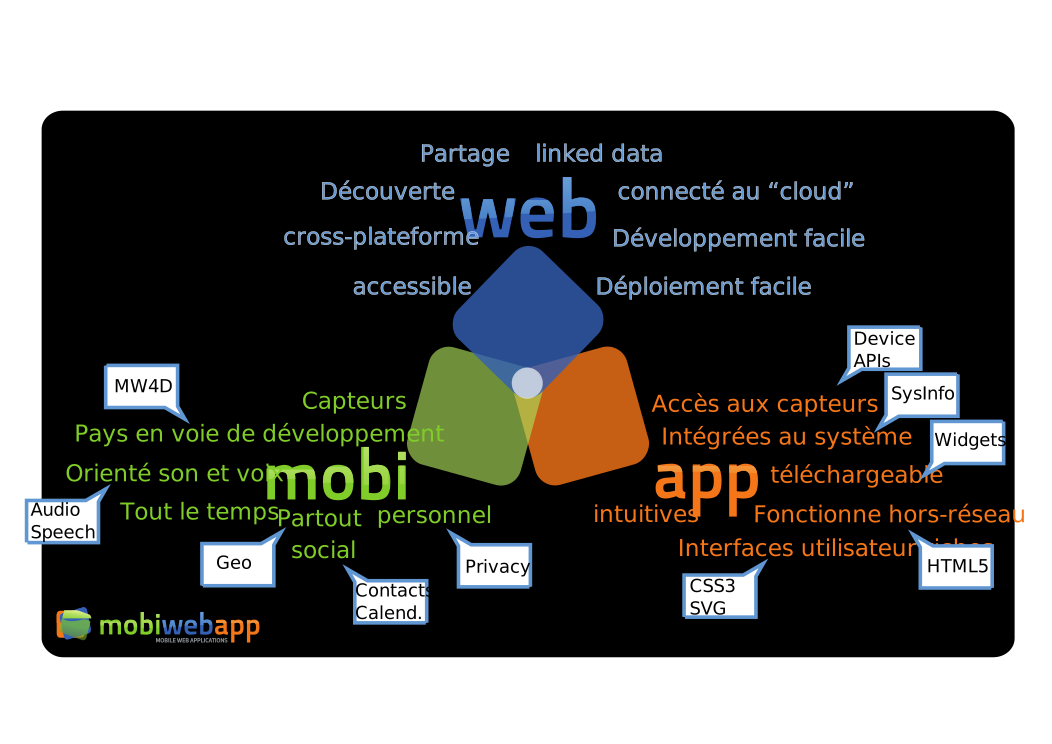
- the MobiWebApp European project in which I’m in charge of the Standardization Work Package, as well as of coordinating the work from other Work Packages
- Web applications development and deployment to facilitate the W3C mission in the W3C Systems Team; most of my coding is done in PHP, Python, and XSLT, although I’m more and more involved in JavaScript deployment as well, and have some rough experience with Java. I’m a strong proponent of open source software and open platforms.
 I’m also to co-author of Relever le défi du Web mobile, a book published in January 2011 on best practices for designing and developing for the mobile Web, in French.
Before my current activities, I served as Staff Contact in the Mobile Web Best Practices Working Group, and as co-Chair of the Mobile Web Test Suites Working Group.
Even earlier, I was Activity Lead of the Quality Assurance Activity and Staff Contact of the Quality Assurance Working Group; I was also involved in the early work on GRDDL and various Semantic Web projects.
I’m also interested in Web Accessibility — as part of a larger focus of mine on usability.
More details about my activities are available in my Work blog and my microblog.
Events
I’m available for speaking engagements, both in French and in English; contact me at dom@w3.org, preferably well in-advance of the event, especially for events outside of Europe.
See also my lanyrd page.
- Upcoming
- HTML5 & the mobile Web, INRIA Lille, February 14 2012
- W3C booth in Mobile World Congress (Hall 2, booth 2A31), February 26-March 1st 2012, Barcelona, Spain
- Tutorial on Mobile Web Applications development, during WWW2012 Tutorial track, Lyon, April 17 2012
- 2012
 The Web: A Platform for Connected Devices
- W3C Spain Day, January 12, Granada, Spain
- 2011
- Browser Panel
- Paris Web 2011, October 14, Paris, France
 Plasticité des IHM: le Web et l’adaptation de contenu
- 2 hours lesson at Polytech’nice, October 7, Sophia-Antipolis, France
 Native ←♥→ Web
- Over the Air 2011, Septempber 30th 2011, Bletchley, UK
 Best Practices for developing Mobile Web Applications
- Open World Forum 2011, September 23, Paris, France
- W3C and Open Data
- Open Data Garage, July 6, Marseilles, France
- HTML5: the new face of the Web panel
- E1 S2 conference, June 10, Toulon, France
- The Web: a platform for applications on connected devices
- Mobile Web Applications Camp, part of the W3C track in the WWW2011 conference, March 31, 2011, Hyderabad, India
- HTML5 et les nouvelles technologies du Web
- 43.117 (Toulon digital companies network) meet up, March 24, 2011, Toulon, France
 The Web: a platform for applications on connected devices (SVG version of the slides)
- Future of Mobile Web Application, W3C Device API Day 2011, March 17, 2011, Seoul, South Korea
 W3C Widgets and the Open Web Platform
- WAC Developer event during Mobile World Congress, February 14, Barcelona, Spain
 Applications Web / Applications Natives
- Panel on Quelles sont les meilleures méthodes de développement d'applications mobiles ? (what are the best methods to develop mobile applications), in Le développement des nouveaux services mobiles, INRIA, January 21, Sophia-Antipolis, France
- 2010
-
 HTML5 et le Web de demain (SVG)
- Paris Web 2010, October 14, Paris, France
- Video of the presentation
 Applications Web Mobiles au W3C (SVG)
- Conférence de Presse W3C, 13 Octobre, Paris, France
 On the Web: mobile and accessible? (SVG slides, HTML paper)
- Invited Speaker on Rich Internet Applications track in 1st International Conference of ÆGIS, October 8, Seville, Spain
 The Next Open Web Platform
- Paris HTML5 Meetup in La Cantine, April 7, Paris, France
- Video
- Input to
 Native or Web Application? How Best to Deliver Content and Services to Your Audiences over the Mobile Phone
- Global Intelligence Alliance Webinar, 8 April
 Sophia-Antipolis BarCamp on Mobile Internet
- Sophia-Antipolis BarCamp, March 4
- Blog report
- 2009
 W3C Cheatsheet for developers (SVG)
- W3C Technical Plenary day, November 4, Santa Clara, CA, USA
 Introduction to W3C’s Mobile Web Best Practices — Live!: challenges, Designing for mobile
- Live training on Mobile Web Best Practices, October 14, Cambridge, United Kingdom
 W3C and the Social Web (SVG)
- 10 Anniversario del W3C Italia, Pisa, Italy, October 7 2009
 Web 2.0 and Beyond (HTML version)
- WITFOR 2009, Economic Opportunities Commission, August 26, Hanoi, Vietnam
 Building Web Apps & Widgets with W3C Standards
- Mobile 2.0 Barcelona Developer Day, June 18 2009, Barcelona Activa, Barcelona (Spain)
 Social Web and Mobile Widgets Bar Camps
- W3C Track in WWW2009, April 23-24 2009, Madrid, Spain
 Device Independent or Accessible
- European Accessibility Forum 2009, March 27 2009, Frankfurt, Germany
- video
 Workshop on the Future of Social Networking
- W3C Workshop, January 15-16 2009, Barcelona, Spain
- 2008
 Workshop on Securing Access to Device APIs
- W3C Workshop, December 11-12 2008, London, UK
 Tutoriel Web mobile
- On-line Access-key Tutorial
 Open/Proprietary/Standards in the Mobile Web industry
- Mobile Web Europe 2008, September 23rd 2008, London, UK
 The Web on the Move session
- W3C track in WWW2008 conference, April 23rd 2008, Beijing, China
- 2007
-
 Les Bonnes Pratiques du Web Mobile
- Paris Web 2007, on November 16 2007, in Paris, France
- audio record (Ogg/Vorbis)
- Video
 Le W3C et l’Initiative pour le Web Mobile
- MobileWeb BarCamp, October 13 2007, Paris
 Le Web mobile, partout et pour tous ?
- First European e-Accessibility Forum, January 29 2007, Paris, France
- earlier…
- See the archives of older talks and presentations.
Projects
A few W3C projects I am/was involved in:
- demos of Web-based multi-devices usage: remote whiteboard and 3D explorer
- W3Connect Web App for TPAC 2011 and W3Connect Web app for Over the Air 2011, based on an open-source node.js powered Web application
- W3C Cheatsheet for developers (source)
- the WebIDL checker (source), and widlproc, a Web IDL parser
- the 2009 redesign of the W3C web site
- organization and co-chairing of the W3C Workshop on the Future of Social Networking in Barcelona, Jan 2009, that led to the creation of the Social Web Incubator Group
- organization of the W3C Workshop on Securing access to Device APIs from the Web in London, Dec 2008, that led to the creation of the Device APIs and Policy Working Group
- the Web Compatibility Tests for Mobile Browsers: first and second version
- the Mobile Test Harness
- co-authored and tutored the on-line course on the W3C Mobile Web Best Practices
- W3C GRDDL service, HTMLDiff service
- the mobileOK checker (and its predecessor, the W3C Mobile Web Best Practices checker)
- Tracker, a W3C internal issues and action items tracking system used by many W3C Working Groups
- the Last Call comments tracker, a W3C internal tool to manage feedback received from the public on W3C specifications
- Planet Mobile Web, an aggregation of blog posts regarding the Web on mobile devices
- the W3C Working Groups management system that serves as a basis for ensuring the proper application of W3C Patent Policy
- WBS, the Web Balloting and Straw Poll
System, a W3C internal tool used to run survey and questionnaires
- the first version of the publication rules
checker and various other spec-editing assistants
- the semantic data extractor
- the W3C mailing list
archives accessibility and usability improvements
- the Glossary project
- the old “W3C new visitors”
page (2002)
- the initial move from table-based to
CSS-layout for the W3C Home page back in 2002
- RDFization of the QA
Matrix
- Automation (and RDFization) of the Technical Reports list management
- the spell checker
Publications
- Standards for Web Applications on Mobile, a regularly updated overview of technologies used to build Web applications on mobile;
- Relever le défi du Web mobile (Eyrolles editions), book in French on developing and designing for the Web on mobile devices
- On the Web: mobile and accessible?, In ÆGIS conference proceedings (PDF), 1st ÆGIS International Conference (HTML version)
- Method for Writing Testable Conformance Requirements, Working Group Note, January 2010
- Guidelines for writing device independent tests, Working Group Note, May 2009
- Return of the Mobile Style Sheet, article in A List Apart, January 2009
- QA Framework Specification
Guidelines, W3C Recommendation, August 2005
- Variability in Specifications, Working Group Note, August 2005
- Bridging XHTML, XML and RDF with GRDDL, accepted paper to XTech 2005 conference, May 2005
- Gleaning Resource Descriptions from Dialects of Languages (GRDDL), co-author of the original Team Submission in May 2005
- Buy standards
compliant web sites, W3C QA Article, July 2002
Office address
W3C/ERCIM
2004, Route des Lucioles
Sophia Antipolis
06410 Biot
France
Misc

Dominique Hazaël-Massieux <dom@w3.org>
Last Modified: $Date: 2012/01/12 19:20:06 $
 Applications Web Mobiles au W3C (SVG)
 W3C Cheatsheet for developers (SVG)
 W3C and the Social Web (SVG)